Zone Oriented Relational Assistant
A Context Aware Operations System
An applied AI project exploring how signals, history, identity, permissions, and real-world conditions can be turned into better operational decisions.
The Problem
Many AI systems add a capable model on top of existing tools without solving the harder problem underneath: what context does the system need before it should act, who is it allowed to act for, and what should happen when that context is incomplete?
More data and more automation do not automatically produce better decisions. Without explicit permission boundaries, confidence thresholds, and a way to escalate uncertainty, AI can simply make the wrong decision faster.
Zora was built to test a different approach: combine multiple imperfect signals into better-informed judgments, operate within explicit rather than assumed authority, fail closed when permissions are unclear, and make failures visible enough to diagnose and improve.
Not more automation. Governed judgment the same discipline operations leadership requires of people, applied to AI.
Design Goals
Combine multiple imperfect signals instead of trusting a single source.
Operate within explicit permissions and bounded authority.
Use confidence thresholds before acting.
Escalate or fail closed when context is insufficient.
Make decisions and failures observable enough to diagnose and improve.
SYSTEM STATUS
Zora Core
Working
Governed RAG
v1.0.0 Accepted
Retrieval Evaluation
Validated
Tool Governance
Validated
Public Demo
Working
Operational Intelligence Expansion
Active Development
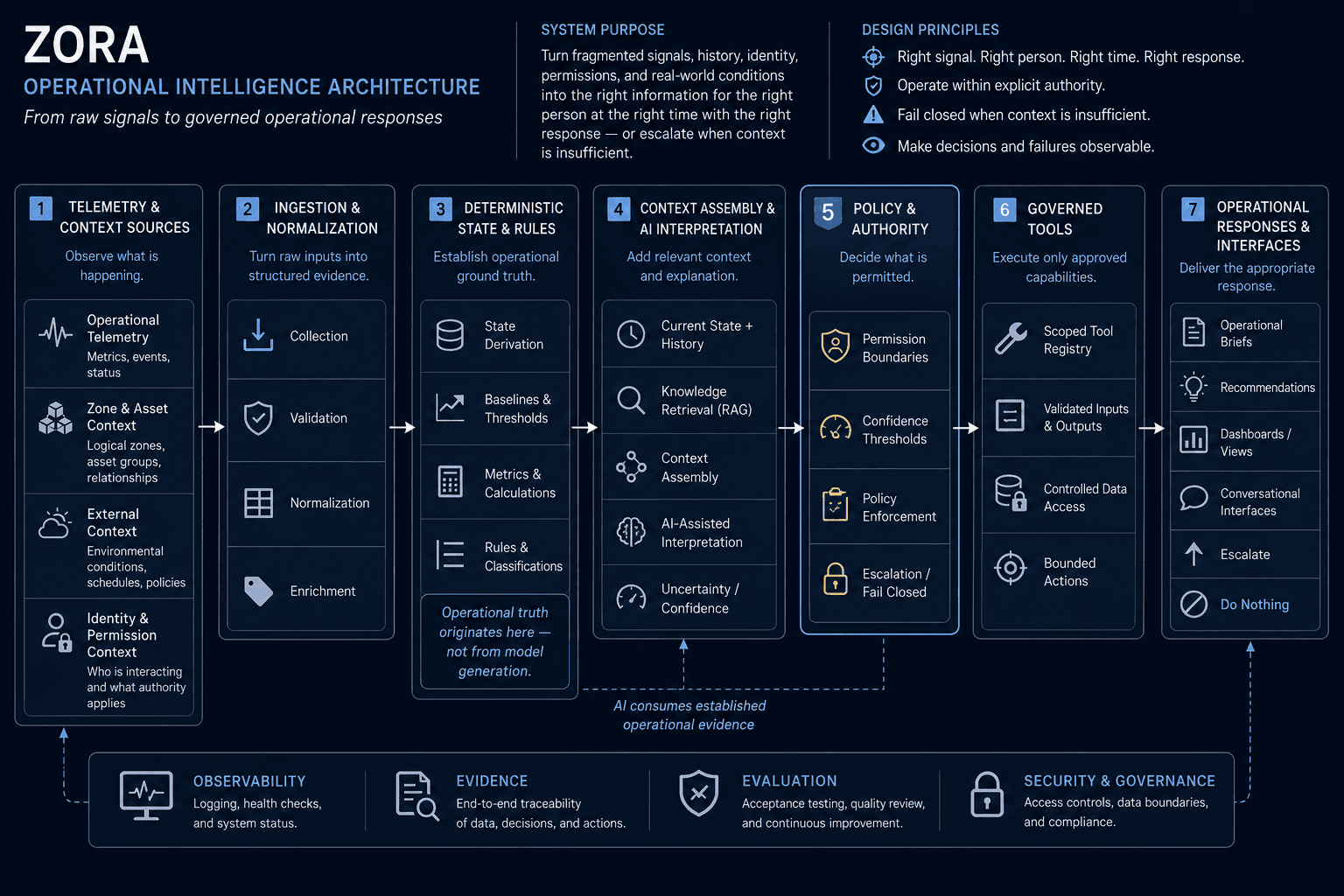
Architecture Overview
THE SITUATION ENGINE
Zora’s first version could answer questions about the house. It couldn’t yet be trusted to know the difference between what it observed and what it assumed.
The Situation Engine is the multi-stage architecture that closed that gap. It governs how raw signals become context, how context becomes judgment, and how judgment becomes authorized action — the same chain of custody I spent nineteen years enforcing in incident response, rebuilt as software.
Telemetry → State → Context → Situation → Judgment → Attention Policy → Action Authority → Execution → Evidence
Each stage exists to answer one question a system has no business skipping:
What is actually happening right now?
What does the evidence support — and what does it not?
Does this deserve a person’s attention, or is silence the correct response?
Is this action authorized, or does it require confirmation, or is it blocked outright?
Did the action actually happen — not just get requested?
The build produced a working rule that now governs every response: observation is not prediction, recommendation is not authorization, and authorization is not execution until evidence confirms it.
A compact, authoritative context representation replaced broad raw sensor exposure — a 99.83% reduction in what reaches the reasoning layer, achieved without losing the information that matters. The system was validated across 149 automated tests spanning governed actions, attention policy, household trust boundaries, and audit logging, then closed with a formal ship decision: stable and useful enough to run and demonstrate, with known limitations documented and bounded rather than hidden.

Tap or click the image to expand.
When room-level presence became temporarily unavailable, Zora preserved the known fact that the resident was home without inventing a room. Once presence tracking recovered, the same question returned the supported location. This is the clearest demonstration of the core principle: the system says what it knows, and says plainly what it doesn’t.

Tap or click to expand.
Whole-house situational awareness: Zora combined resident location, indoor comfort, outdoor conditions, HVAC state, and attention status into one concise household summary — without exposing raw sensor data or requiring a technical query.

Tap or click to expand.
Context-aware comfort control: Zora interpreted “Can you make it cooler in here?” as a comfort goal, checked indoor and outdoor conditions, rejected passive cooling as unhelpful, and completed the thermostat change through a natural follow-up.
See the full engineering evidence →
01 — Telemetry & Data Sources
Operational Telemetry
High‑resolution signals from meters, sensors, controllers, and equipment.
Zone & Asset Context
Logical zones, asset groups, relationships, and operating context.
External Context Feeds
Environmental conditions, schedules, policies, external APIs, and operational constraints.
These inputs form the foundation of ZORA’s deterministic truth layer.
02 — Ingestion & Storage
Ingestion Layer
Agents/collectors parse and timestamp incoming signals.
Time‑Series Database
High‑resolution storage with retention windows (24h–90d) for baselines, trends, and historical context.
Metadata & Policy Store
Asset definitions, zone mappings, monitoring policies, thresholds, and calibration data.
This layer ensures ZORA has reliable, structured evidence to reason from.
03 — Deterministic Processing & Calculations
State Derivation Engine — Determines asset and zone states (active, idle, normal, abnormal).
Metrics & Aggregations — Moving averages, min/max, baselines by state, deviation analysis, coverage percentages.
Classification & Rules Engine — Compares current conditions to historical baselines and approved policies to produce operational classifications, recommended responses, uncertainty flags, and health checks.
Deterministic System of Record — Telemetry, states, baselines, thresholds, and rules form ZORA’s ground truth.
04 — AI‑Assisted Context & Explanation
RAG / Knowledge Retrieval — Vector search over approved knowledge bases: procedures, best practices, domain playbooks.
LLM Context Engine — Synthesizes deterministic outputs + retrieved knowledge to generate operational briefs, zone‑level explanations, deviation analysis, decision rationales, and uncertainty notes.
Governed Tools (MCP) — Approved capabilities expose controlled access to operational data, analysis, retrieval, and bounded actions.
05 — OPERATIONAL RESPONSES & INTERFACES
Operational Briefs
Structured summaries of current state, deviations, contributing signals, uncertainty, and recommended next steps.
Interfaces & Views
Dashboards and interfaces expose current state, trends, coverage, data quality, and system health.
Operational outputs are designed to remain traceable to supporting evidence.
06 — Infrastructure & Deployment
Compute Environment — Containerized services for ingestion, storage, deterministic processing, AI layer, and visualization.
Storage & Backups — Controlled storage for time‑series data, configs, and knowledge bases with retention and recovery policies.
Security & Governance — Scoped tools, public/private separation, controlled access, and explicit data boundaries constrain what each interface can see and do.
07 — Design Principles
Deterministic Grounding
Operational state is established before model interpretation.
Separation of Concerns
Telemetry, state derivation, retrieval, AI interpretation, tools, and interfaces remain distinct layers.
Governed Interfaces
Models interact with operational capabilities through scoped contracts rather than unrestricted system access.
Observable by Design
Logging, health checks, evaluation, and acceptance testing make failures diagnosable.
08 — IMPLEMENTATION
A Governed Data Foundation
Zora ingests operational telemetry, normalizes it into structured state, and preserves historical context for comparison and analysis. Deterministic calculations establish the evidence layer before AI is asked to interpret it.
Retrieval as Institutional Memory
A RAG layer retrieves approved procedures, system knowledge, operating rules, and historical context when they are relevant to the current situation. Retrieval is bounded so the model can use available evidence without treating unsupported information as fact.
Controlled Tools, Not Unlimited Agency
Zora accesses capabilities through governed tools with defined inputs, outputs, permissions, and failure behavior. Tools expose only the information or action required for a task rather than giving the model unrestricted access to underlying systems.
Context Before Response
Current state, history, identity, permissions, retrieved knowledge, and confidence are assembled before a response is produced. The resulting context determines whether Zora should inform, recommend, act within approved authority, escalate, or do nothing.
09 — TESTING & VALIDATION
Test the Boundaries, Not Just the Happy Path
Validation included expected behavior, missing data, unavailable services, malformed requests, unsupported questions, and attempts to access information outside approved boundaries. A system was not considered successful simply because the ideal query worked.
Retrieval Had to Be Measurable
The knowledge layer was evaluated against known-answer questions rather than judged by whether responses merely sounded plausible. Formal retrieval evaluation achieved 98% Top-1 accuracy, 100% Hit@3, and 99% MRR, with later acceptance runs reaching perfect retrieval scores on the defined evaluation set.
Tool Access Had to Fail Correctly
Live integration tests verified tool discovery, approved requests, contract validation, and refusal behavior. Separate deterministic validation passed 45 of 45 tests, while the final RAG acceptance suite passed all 16 required checks.
Real Interfaces Were Part of Acceptance
Validation extended beyond backend services into conversational and endpoint behavior. Zora had to select the correct capability, return a bounded response, expose uncertainty or limitations, and remain consistent when accessed through real interfaces rather than only through developer tests.
Acceptance-Test Evidence
Retrieval-Evaluation Evidence
Working-System Demo
10 — RESULTS
Evidence Before Explanation
Operational claims can be traced back to telemetry, derived state, historical evidence, or approved knowledge rather than being generated solely by the model.
Governed Access Works
The model can discover and use approved capabilities while requests outside defined permissions or supported scope are rejected instead of approximated.
Context Changes the Response
The same signal can produce different outcomes depending on history, current conditions, permissions, confidence, and available evidence. Zora can provide information, recommend a response, escalate uncertainty, or intentionally take no action.
The Architecture Is Modular
Telemetry, deterministic processing, knowledge retrieval, AI interpretation, governed tools, and presentation interfaces remain separable. Individual components can change without redefining the entire system around a single model or interface.
11 — FAILURES & LESSONS
Prompting Is Not Governance
FAILURE
Early routing relied too heavily on model instructions to choose the correct tools and stay within scope. The model could select an inappropriate capability or infer relationships that the available evidence did not support.
LESSON
Important boundaries belong in architecture, not prose. Tool registration, permissions, schemas, validation, and explicit refusal behavior now enforce constraints the prompt alone could not reliably provide.
Correlation Is Not Causation
FAILURE
Early analysis could produce mathematically plausible relationships from summarized data without enough temporal alignment to support the conclusion.
LESSON
Operational analysis requires synchronized evidence. Correlation logic was moved toward aligned time-series data, and unsupported attribution or causation is withheld rather than presented as fact.
Unsupported Features Should Fail Clearly
FAILURE
When a requested comparison or analysis was not actually supported, approximating an answer created the appearance of capability without trustworthy evidence.
LESSON
Zora now prefers a bounded limitation over a convincing guess. Unsupported capabilities are removed, refused, or escalated until the underlying evidence and tooling exist.
Response Is Not Proof of Completion
FAILURE
A successful interface or tool response could confirm that a request was received without proving that the underlying operation completed as intended.
LESSON
Acceptance distinguishes request receipt from verified completion. Outcomes that cannot be verified remain explicitly unverified.
12 — LIMITATIONS
The system is deliberately bounded.
Prototype Scope
Zora is a working operational intelligence system, but it is not presented as a finished commercial platform. Some infrastructure, interfaces, and integrations remain specific to the environment in which the system was developed.
Context Is Not Certainty
Telemetry and contextual signals can be incomplete, delayed, noisy, or contradictory. Zora uses confidence, corroborating evidence, and explicit uncertainty rather than treating every available signal as equally trustworthy.
Authority Remains Bounded
Zora does not assume permission to act simply because a capability exists. Actions remain constrained by defined tools, permissions, policy boundaries, and the ability to escalate or take no action when authority is unclear.
Production Hardening Continues
Long-term resilience, identity management, recovery behavior, security controls, observability, and large-scale deployment would require additional hardening before the architecture should be treated as production-ready for a broader operational environment.
13 — NEXT STEPS
The next phase expands the operational context Zora can reason over.
External Operational Intelligence
Expand governed ingestion of authoritative external signals such as grid conditions, weather, hazardous conditions, and other operational context so Zora can reason beyond internally generated telemetry.
Historical Replay & Evaluation
Use previously captured operational data to replay past conditions, test decision logic, compare system behavior, and improve evaluation without waiting for the same real-world event to happen again.
Better Context Correlation
Continue improving how telemetry, history, knowledge, identity, permissions, and external conditions are combined so Zora can distinguish meaningful context from coincidental or low-confidence signals.
Architecture, acceptance results, retrieval evaluation, demonstrations, screenshots, and development records document how Zora was designed, tested, and improved.