ZORA ENGINEERING EVIDENCE
ACCEPTED MVP · SEPTEMBER 2026
MVP accepted September 23, 2026 · 133/133 automated tests passed · end-to-end telephone acceptance passed
ZORA Grid Operations applies the same governed architecture to a new domain: public California grid data. It turns reported conditions into a concise, evidence-based explanation, demonstrating architecture portability, operational judgment, and clear limits on what an AI system can claim.
Public data to governed explanation
Public CAISO Data
Ingestion & Normalization
Time-Series Storage
Deterministic Analysis
Governed ZORA Tools
ZORA Explanation / Telephone
Public data becomes structured evidence before it reaches the conversational interface. Each layer has a distinct responsibility, keeping calculations, data quality, and human explanation separate.
What ZORA adds
• Forecast deviation
• Short-window demand movement
• Capacity headroom
• Freshness and missing-data checks
• Artifact coherence
• Governed conversational access
These checks establish what can be reported, what has changed, and where the available evidence needs qualification.
Bounded by the evidence
ZORA does not infer unsupported causes, grid reliability, dispatch motive, or trading conclusions. It does not speak with CAISO authority. Missing or stale data limits the explanation; a plausible narrative is not a substitute for supported facts.
Operational judgment includes knowing when the evidence is insufficient and making that limit visible to the person asking.
MVP validation
133 / 133
Automated tests passed
PASS
Private and Public ZORA paths validated
PASS
SIP / telephone end-to-end acceptance passed
Accepted release tag: grid-mvp-2026-09-23
Ask ZORA about the California grid
Ask a plain-language question about the reported conditions. The public telephone experience brings the governed result to a familiar interface, with the same evidence boundaries.
• What’s happening on the California grid right now?
• What is demand doing?
• What are the batteries doing?
• How much capacity headroom is being reported?
• What are wind and solar contributing?
• What are the current natural-gas emissions?
Call ZORA
323-992-ZORA
Independent demonstration using public CAISO data. Not affiliated with CAISO. Not for grid operations, dispatch, trading, or market decisions.
VERIFIED RELEASE
Zora RAG v1.0.0 reached final acceptance after configuration, retrieval, service, tool, and interface validation.
ZORA RAG
v1.0.0
FINAL ACCEPTANCE
PASS
16 / 16
REQUIRED CHECKS
PASS
DETERMINISTIC VALIDATION
234 points
KNOWLEDGE INDEX
Evaluation: PASS
Qdrant: v1.18.2
MCP SSE acceptance: PASS
System doctor: no blocking problems
View final acceptance
RETRIEVAL EVALUATION
Known-answer evaluation tested whether Zora retrieved the expected supporting evidence rather than merely producing plausible responses.
98%
Top-1 Accuracy
100%
Hit@3
99%
MRR
In practical terms: when Zora was tested against questions with known answers, the correct evidence was retrieved first 98% of the time and appeared within the top three results every time.
RETRIEVAL EVIDENCE
Governed History: Known-Good Checkpoint
August 6, 2026 PASS
Retrieval evaluation passed with 98% Top-1 accuracy, 100% Hit@3, and 99% mean reciprocal rank. The same checkpoint verified an unknown-content negative case without weakening retrieval thresholds.
Public-safe extract; private infrastructure and identifying implementation details are omitted while the reported validation results are preserved.
View checkpoint
CONTROL & BOUNDARY VALIDATION
Acceptance testing included approved behavior, unsupported requests, tool boundaries, known retrieval, unknown refusal, and interface-level failure behavior.
Tool Access
PASS
Deterministic validation tested tool discovery, approved requests, contract behavior, and bounded failure paths.
End-to-End Interface
PASS
MCP SSE connection, tool discovery, known retrieval, and unknown refusal were verified through the working system interface.
Fail-Closed Behavior
PASS
Unsupported or insufficiently evidenced requests remain bounded rather than being presented as verified capability.
BOUNDARY EVIDENCE
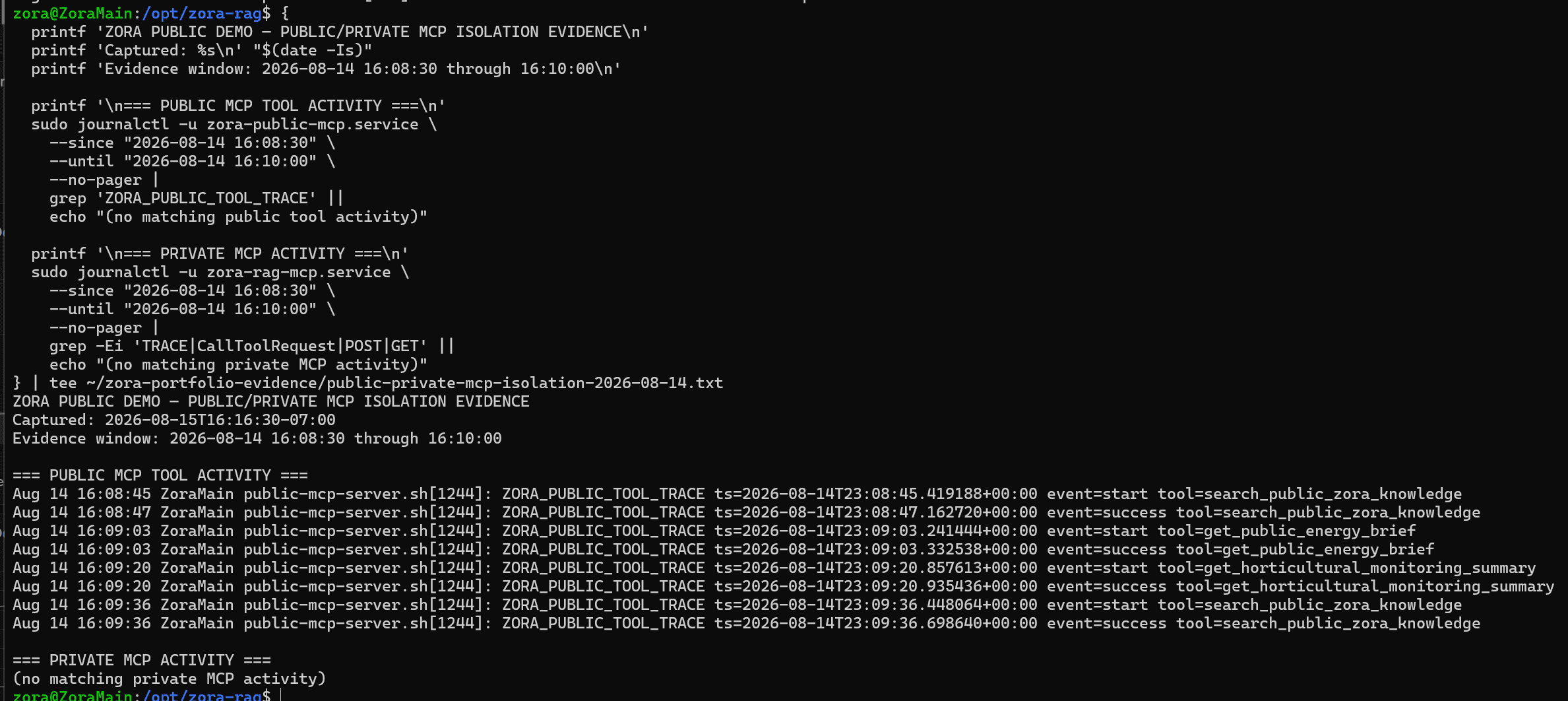
Public-demo tool activity was recorded through the public MCP service while the corresponding private MCP service showed no matching activity during the same evidence window.
Evidence window: August 14, 2026 16:08:3016:10:00
View full evidence
CHECKPOINT EVIDENCE
Governed History Acceptance
PASS
146 automated history tests passed with zero failures. The same checkpoint also passed six conversational validation questions, checked 11 live governed entities with zero audit failures, and verified public MCP SSE acceptance, privacy protection, coverage disclosure, and unsupported-question rejection.
146 automated 6 conversational 11 live entities 0 audit failures
Public-safe extract; private infrastructure and identifying implementation details are omitted while the reported validation results are preserved.
View checkpoint
WORKING SYSTEM
Zora was exercised through real interfaces so evaluation reflected the behavior a user or operator would actually encounter.
Context-Aware Operations Demonstration
Recorded from the working Zora system and used to show context assembly, governed tool use, evidence-based responses, and boundary awareness.
Watch Zora
ENGINEERING RECORD
Release documentation, architecture records, evaluation results, recovery procedures, and acceptance evidence were maintained alongside the implementation.
Release v1.0.0
DOCUMENTED
Architecture
DOCUMENTED
Quickstart
DOCUMENTED
Runbook
DOCUMENTED
Ingestion
DOCUMENTED
Evaluation
DOCUMENTED
Recovery
DOCUMENTED
Acceptance Evidence
DOCUMENTED
SITUATION ENGINE
The Situation Engine closed the MVP with a formal ship decision, a frozen architecture, and a full cross-phase regression suite — rather than an open-ended feature list.
ROOM-STATE TRACKING

Tap or click the image to expand.
Live room-state transitions: the Situation Engine tracked movement between tracked rooms in real time. During one ambiguous handoff, it temporarily returned “unknown” rather than inventing a location.
GRACEFUL DEGRADATION

Tap or click the image to expand.
When room-level presence became temporarily unavailable, the system preserved the known fact that the resident was home without inventing a room. Once presence tracking recovered, the same question returned the correct, supported answer.
REGRESSION EVIDENCE

Tap or click the image to expand.
149 tests passed across governed actions, proactive attention policy, household trust boundaries, privacy isolation, and audit logging — the full closeout regression for the Situation Engine MVP.
Read the full Zora case study →
The case study explains the architecture and decisions. The demonstration shows those decisions in operation.